
Last updated: 3 November 2026
| Quick answer: Many shift workers find it hard to book dental hygiene care around rotating, evening or night schedules, so cleanings get put off. Employers can help by bringing care to the workplace. Dental Care in Motion’s workplace dental hygiene service plans appointment windows around shifts, subject to availability, for workplaces within a one-hour drive of Hamilton, Ont. |
For employees who work rotating, evening or overnight shifts, finding time for a dental cleaning can be difficult. Appointments may conflict with work schedules or much-needed sleep, forcing employees to take time off or delay routine care. According to Statistics Canada’s 2023-24 Canadian Oral Health Survey, 28 per cent of Canadians had not visited an oral health professional in the previous 12 months. For shift workers, irregular schedules can create another barrier to getting the dental care they need.
Why shift workers struggle to keep up with dental hygiene
The reasons are usually practical, and you will likely recognize them on your own floor:
- Hours that clash. Daytime appointment slots can land right when night-shift staff are trying to sleep.
- Schedules that rotate. When shifts change from week to week, booking a visit weeks ahead is hard.
- Cost. In the same 2023/2024 survey, 24 per cent of Canadians aged 12 and older avoided an oral health professional at least once because of cost. That rose to 45 per cent of people without dental insurance, compared with 12 per cent of people with insurance.
- Evening work in some industries. In April 2022, about one in 20 Canadian workers (4.8 per cent) usually worked evenings, rising to about one in five (21.8 per cent) in accommodation and food services, according to Statistics Canada’s study on evening work.
Tips you can share with your team
The Canadian Dental Association’s daily dental care advice says to brush for two to three minutes, twice a day, with a fluoride toothpaste, and to floss at least once a day to remove plaque and food a toothbrush can’t reach. After a night shift, one of those brushings can simply come before sleep, even if bedtime falls in the morning. These habits support daily oral care at home. They don’t replace a professional cleaning.
Some signs need a dentist, not just a cleaning. The Canadian Dental Association’s list of warning signs includes bad breath that doesn’t go away with daily brushing and flossing, gums that bleed almost every time you brush or floss, bleeding you can’t explain, a sore or numb feeling inside the mouth, a loose tooth, white or red patches and mouth sores that don’t heal in seven to 10 days. It advises seeing a dentist for these signs, and right away for some, such as sores that don’t heal or bleeding you can’t explain. Encourage staff who notice them to book with their dentist.
What two studies on shift work found
Two recent studies give a mixed picture: A 2022 study of 180 male cement factory workers in Iran found that more years of shift work went along with more decayed, missing or filled teeth and more deep gum pockets. Once the researchers adjusted for other factors, shift work itself showed no effect, and age may explain the link. A 2024 survey of 3,044 Japanese employees, based on employees’ own answers to an online questionnaire and published in PeerJ, reported that workers on short-term rotating night shifts may have poorer oral conditions; its authors say more research is needed. Both studies are surveys taken at one point in time, so they can show a link but not a cause.
How workplace dental hygiene helps employers with shift workers
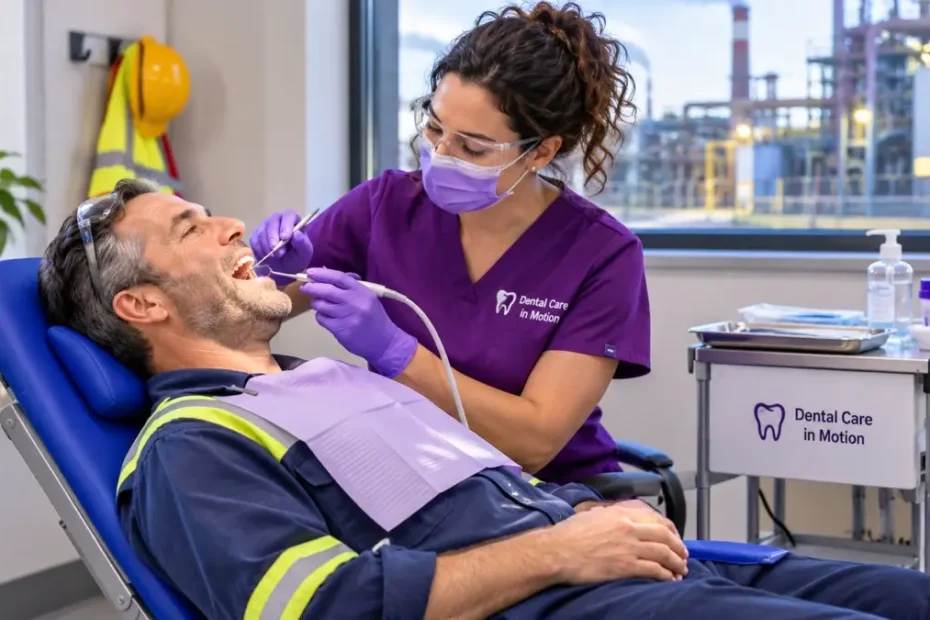
Dental Care in Motion is a mobile dental hygiene service based in Hamilton, Ont. We bring care to clients in their homes, offices and long-term care homes. Through our workplace dental hygiene service for employers, our hygienists can serve your company’s employees on site.
Instead of asking staff to fit a visit around their shifts, the visit comes to your workplace. We offer three options:
- Workplace Smile Days: a planned day of individual appointments at your site.
- Shift-Worker Dental Hygiene: appointment windows planned around production shifts or warehouse schedules, subject to availability.
- Ongoing Workplace Visits: repeat visits through the year, so staff can come back for care.
What a visit may include
Workplace services may include a dental hygiene assessment (a registered dental hygienist’s review of the teeth, gums and mouth), hand-scaling (removing hardened plaque, called tartar, with hand instruments), polishing, fluoride treatments, oral cancer screening, oral hygiene education and recommendations for further treatment when needed. We confirm which services are available before booking.
For infection control, we use pre-sterilized instruments. We also set up medical-grade air filtration in the work area before appointments begin.
What to expect for your team
On-site care may make it easier for employees to fit a hygiene visit into their week without giving up sleep or a day off. Repeat visits through the year can also help staff keep up with regular care.
Care is planned for each person. Whether a treatment suits someone depends on their health history, and a clearance from a physician or dentist may be needed before some care. We recommend employees follow up with their dentist for restorative dental needs, such as repairing a tooth.
How to set up dental hygiene visits at your workplace
Here is how it works from your first contact to the first appointment day.
Step 1: Send an inquiry
Use the corporate inquiry on our workplace dental hygiene page to share your company name, workplace location, an estimate of how many employees may be interested and your preferred times. This is an inquiry, not a confirmed booking.
Step 2: Talk through your shifts
We discuss how many employees are interested, your shift patterns and the appointment windows that could work. Visits depend on location, employee demand, scheduling and suitable space.
Step 3: Review the space
Your workplace provides a suitable private space, and we review it with you before booking.
Step 4: Decide who pays
Choose employee-paid or employer-supported care. Fees are guided by the Ontario Dental Hygienists’ Association fee guide.
Step 5: Prepare each employee
Before an appointment, each employee has a pre-screening phone call, including a verbal review of medical or dental concerns and any clearances needed.
Step 6: Confirm privacy
We confirm privacy arrangements with you before services begin.
We serve addresses within a one-hour drive of Hamilton, Ont., including Hamilton, Burlington, Oakville, Niagara and surrounding communities. You can see our mobile dental hygiene service area and read more about how mobile dental hygiene appointments work.
Questions employers ask about workplace dental hygiene
Who pays, the employer or the employee?
Either can work, as set out in the steps above. Our mobile dental care pricing page explains how fees are set.
Will our group dental insurance cover it?
Most dental insurance plans are accepted, and we can often submit claims directly to the insurer. Coverage varies by plan, so we don’t assume any plan covers the service. Payment, insurance and any group arrangements are discussed when we plan your program.
What space do we need to provide?
A suitable private space for clinical care. Before booking, we review access, the room, equipment and infection-prevention needs. Requirements depend on the services involved.
Will we see our employees’ dental information?
Individual clinical information is handled as patient information, not as a report to an employer. Specific arrangements are confirmed before services begin.
Can you work around our shift schedules?
We can plan appointment windows around production shifts, warehouse schedules or other non-traditional working hours, subject to availability. We talk through your shift patterns when we plan your program, as described in the steps above.
What do employees need to share before their appointment?
Each employee has a pre-screening call. It covers their medical and dental history or concerns and any clearance from a physician or dentist that may be needed before care.
Which areas do you serve?
Workplaces within about an hour’s drive of Hamilton. See our service area page.
Related pages
- Workplace dental hygiene for employers
- How mobile dental hygiene appointments work
- Mobile dental care pricing and insurance
- Meet the Dental Care in Motion team
Medical disclaimer
This page is general information. It is not a diagnosis or a substitute for care from a dentist, physician or other qualified health professional.